3 Days in Lisbon: City, Coast, and Everything Between
Lisbon is built across seven hills, a working port for over a thousand years. 3 days in Lisbon is enough to actually see the city, not skim it. It’s also the floor, not the ceiling. I’ve done this itinerary twice now, and both times I wanted a fourth day before I was ready to admit it. This is built for the kind of traveler who wants to see everything and somehow still have it feel like a relaxed trip, which doesn’t fully make sense until you’re standing in Alfama with nowhere in particular to be.
The Practical Edit
Short on time? Here’s what you need to know about Lisbon, Portugal.
When to Visit
April, May, September, or October
Shoulder season gets you the good weather without peak-summer crowds.
How Long
3 days minimum
4 to 5 if your schedule allows for a slower pace.
Getting There
Fly into Lisbon (LIS)
Give yourself 2.5 to 3 hours before departure for your flight home. Trust me on this one, I usually cut it close and stressed through the lines with just 2 hours. LIS has a real reputation for slow lines.
Getting Around
Walking and public transit
Skip renting a car in the city itself, parking is expensive and the driving is worse.
Currency
Euro (€). Most places take cards. Keep some cash for street vendors.
Where to Stay
Chiado or Bairro Alto for walkability and access. See the full breakdown below. Or see my neighborhood guide for a complete breakdown to help you decide the best neighborhood for you!
BOOK AHEAD
All the things worth booking before you land.
- Pena Palace tickets in Sintra. Book at least 4 days out for the online discount, more in peak season for an ideal timed slot.
- A tuk-tuk or guided walking tour, if that’s how you’re starting Day 1. Book a few days to a week out in peak summer.
- A combined Sintra and Cascais day tour, if you want the stress-free version of Day 3. Book this 1 to 2 weeks out in high season.
- Jerónimos Monastery cloister, if you’re adding Belém. Skip-the-line booking can be worth it.
- A fado dinner, if that’s on your list. Fado is Portugal’s soulful, guitar-driven folk music, and a handful of Alfama restaurants pair a set meal with a live performance. Book a few days out, the good ones fill up.
3 Days in Lisbon Itinerary Overview
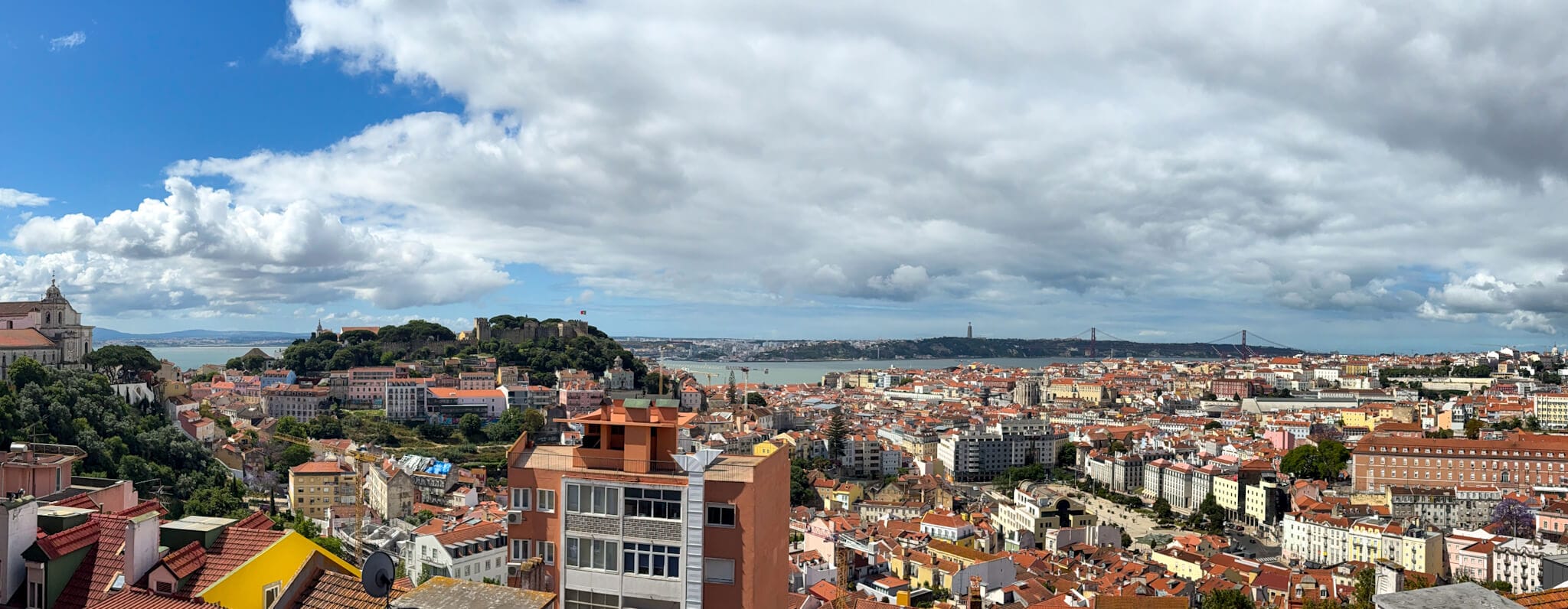
Lisbon is built across seven hills, and the city’s shape today still comes down to one very bad morning in 1755: an earthquake, a tsunami, then a fire, all before lunch. The riverside city was flattened. Downtown came back rebuilt in straight lines and right angles, engineered to survive the next one. The hills mostly didn’t need rebuilding, so they stayed a tangle of narrow streets, which is why Alfama still feels like it was designed by someone who’d never heard of a right angle.
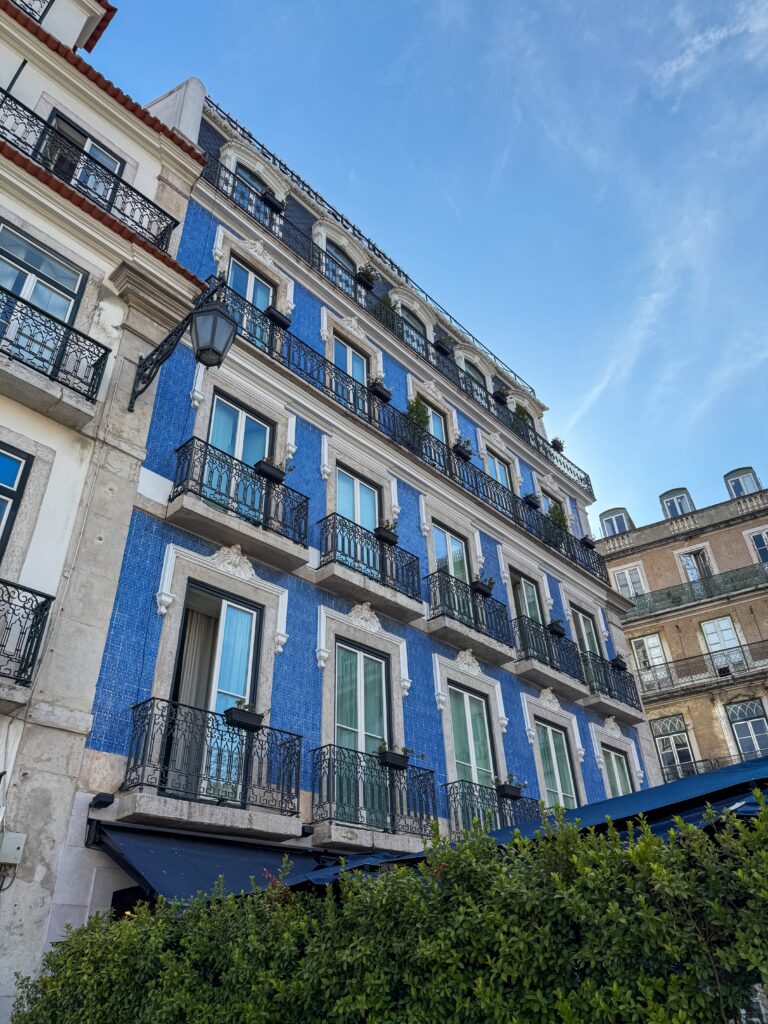
A few things you’ll notice everywhere, regardless of which half of the city you’re in: hand-painted azulejo tiles across entire building facades, and calçada portuguesa, the black-and-white mosaic cobblestone pavement you’ll see spread across various parts of the city. The infamous yellow Tram 28 threads through several neighborhoods on one route, which is a nice ride at 7am but a tourist-clogged photo op by noon, more on that later.
Here’s how your 3 days break down, at a glance:
- Day 1: Baixa, Cais do Sodré, Chiado, and Bairro Alto. Your first taste of the city via a DIY walking tour, a tuk-tuk, or a guided tour, whichever fits your energy and patience for planning.
- Day 2: Alfama, Graça, and Belém. Alfama is Lisbon’s oldest neighborhood, steep and circular, with Graça climbing higher still just beyond it. If you have the energy, the afternoon can stretch further along the river to Belém, the epicenter of Portugal’s Age of Discovery.
- Day 3: Sintra and Cascais. Colorful palaces nestled into a beautiful hillside town and a quiet beach town, combined into one full day out of the city.
Want to just plug all this into your GPS and go? View the interactive map!
Know Before You Go…
One thing worth knowing before you start walking any of this: Lisbon looks compact on a map. It is not, once those seven hills are factored in. If you’ve been to San Francisco, the up-and-down of the streets will feel familiar, but some of the gradients here would embarrass San Francisco’s steepest climbs.
So make sure to bring comfortable shoes! I walked ten miles in unsupportive ones on my first trip and spent the rest of it covered in blisters. Consider this me saving you from my own mistake. The same mosaic stones underfoot are gorgeous but they’re slippery when wet and uneven enough to roll an ankle on a dry day.
Day 1: Baixa, Cais do Sodré, Chiado, and Bairro Alto
Start with coffee and a pastel de nata, the custardy little tart Lisbon is famous for. You’ll want the sugar before you start walking the hills. Fábrica da Nata is the one every guide points you to first, conveniently located in Baixa, but Manteigaria is the better version, with a few locations around town. If you want to make it a game, grab one at each and compare, see if you agree with me (you will).
Your Call: DIY, Tuk-Tuk, or Guided Tour.
You’ve got three real ways to spend today, depending on energy and budget, and none of them is objectively correct, they just suit different travelers.
Option A: A tuk-tuk tour. This is the middle ground, private, with zero route-planning required. It’s a great overview of each neighborhood, with the history coming from a real guide, so you know exactly which spots to come back and cover on foot later. Mornings work best for this, leaving the afternoon free to return to whatever caught your attention.
What I’D BOOK
Splurge: I can’t recommend Tuk On Me enough. They run a number of tours, but if you want the exact one I did, book the 2-hour Lisbon Seven Hills Tuk Tuk Tour, though I’d go for the 4-hour version if I did it again.
Save: If that’s outside your budget, this tour covers similar ground for less, though with a heavier focus on the Alfama area.
Option B: A guided walking tour. You’ll get the history without the tuk-tuk price, though the tradeoff is how much ground you can cover in a set window. I haven’t done this route myself, but a colleague booked this walking tour, mostly skipped Alfama on it, covering that neighborhood herself afterward, close to the split this itinerary already has you doing.
Option C: A DIY walking tour. This is free and gives you full control, but it asks more of you if you’re jet-lagged or don’t feel like planning. If you’re the type who’d rather wander with a rough map than follow someone else’s schedule, start here. I’ve broken down every stop below, plus the interactive map if you want to save it and follow along.
Baixa
You’ll start the day in Baixa, the flat rebuilt grid downtown and the most literal evidence of the 1755 rebuild. After your pastel de nata (or two), head to Rossio Square, marked by its wave-patterned calçada portuguesa, the towering Column of Pedro IV, and two grand baroque fountains.
Swing by A Ginjinha for a shot of the local sour cherry liqueur, poured from the same spot since 1840. It’s early, I know, but you’re on vacation, and it’s only a shot!
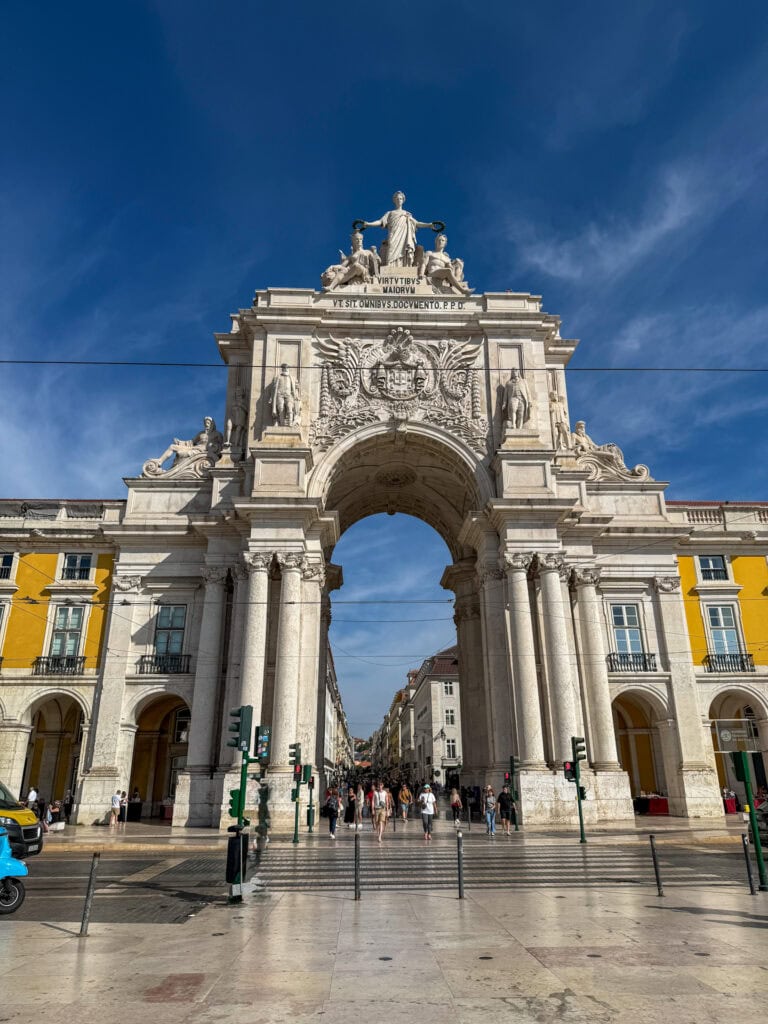
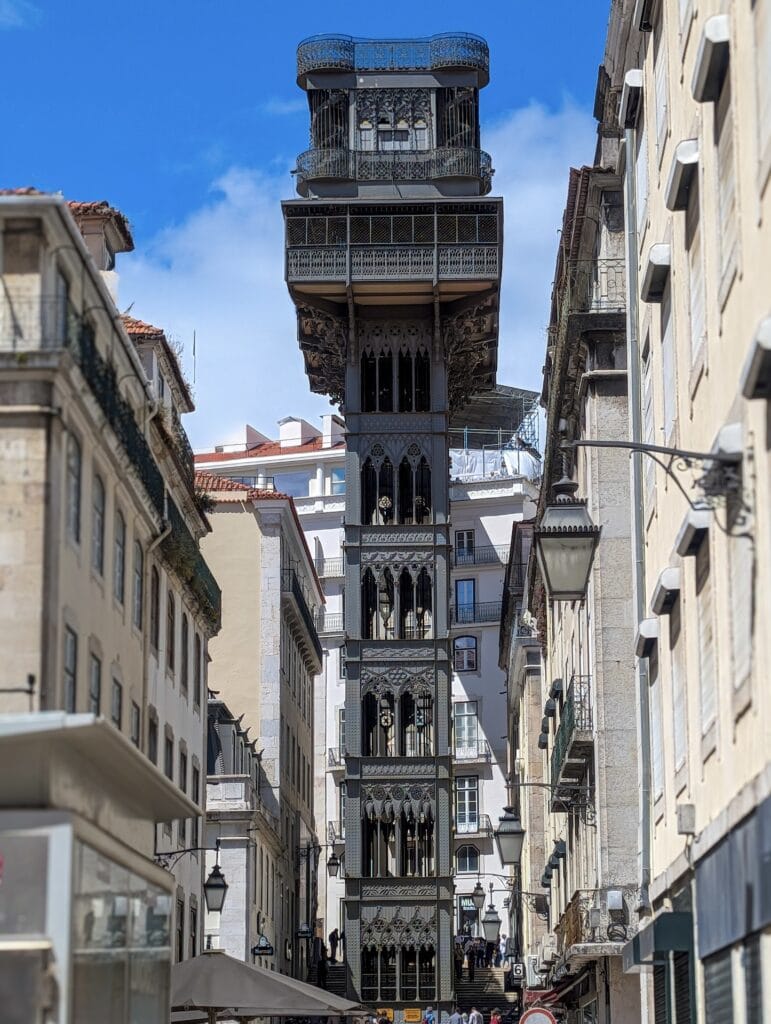
As you head toward the river, you’ll pass the Elevador de Santa Justa, a wrought-iron elevator over a century old, built to help residents avoid the steep climb between Baixa and Chiado. Keep heading south down Rua Augusta, past the shops and the shifting cobblestone patterns underfoot, until you reach Praça do Comércio, Lisbon’s grand waterfront square. It was once the site of the Royal Palace and Portugal’s maritime trade gateway before becoming the monumental symbol of the city’s rebirth after 1755.
Cais do Sodré
Walk west and you’ll land in Cais do Sodré, the riverside stretch between Baixa and the climb up to Chiado. It was once the city’s red-light district and now its most concentrated stretch of nightlife. Stop for lunch at Time Out Market, more on that below.
Afterward, walk through Pink Street, officially Rua Nova do Carvalho, painted pink when the neighborhood reinvented itself from red-light district to nightlife strip. I recommend visiting in the daylight if sticky-floor bar crowds aren’t your thing. The street looks completely different once the bars open.
Chiado
Head up into Chiado next, a neighborhood filled with wrought-iron balconies and old-money storefronts. Walk past A Brasileira, the old café where the poet Fernando Pessoa was a regular, writing for hours at the same table day in and day out. His bronze statue is still sitting at an outdoor table for a photo.
Next door, Livraria Bertrand is the world’s oldest operating bookshop, open since 1732. Step inside, if only for the smell of old paper in a bookshop older than the United States.
Bairro Alto
Finally, climb into Bairro Alto, quiet by day and one of Lisbon’s densest restaurant and bar districts by night.
Wander through the streets until you come to the Igreja de São Roque. It’s worth a peek inside for its interior alone where you’ll find gilded woodwork and rare marbles behind a very plain exterior. You might pass by little yellow funicular routes connecting various parts of these neighborhoods, though most of Lisbon’s historic funiculars have been closed since a fatal derailment on the Glória line in September 2025. The hills haven’t gone anywhere, you’ll just be walking them instead.
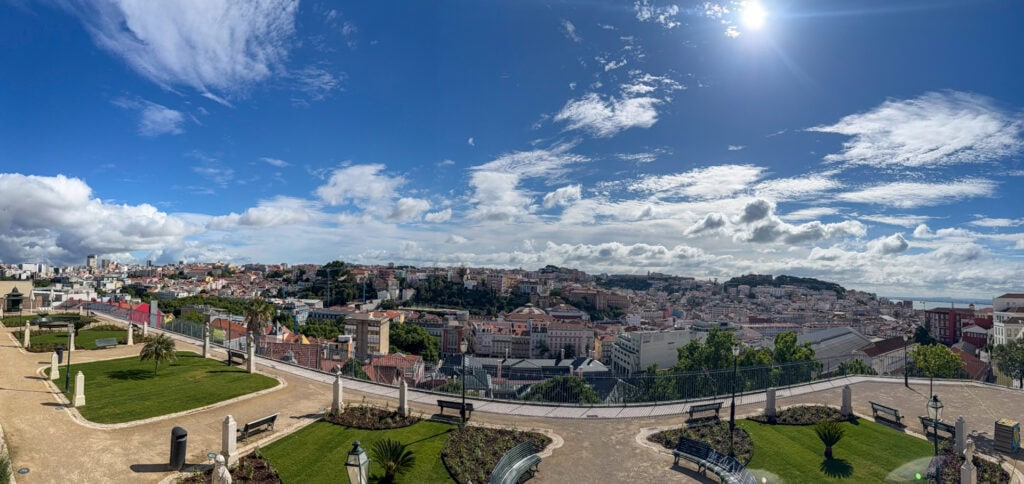
Don’t miss the Miradouro de São Pedro de Alcântara, one of the city’s many miradouros (simply Portuguese for viewpoint, you’ll get used to the word fast). It’s best at sunset, though I’ll admit waiting for a 10pm sunset in peak summer tests your patience. No judgement if you decide to skip the sunset part.
This is the neighborhood for a drink before you eat, and dinner after, before heading back to wherever you’re staying.
Worth the Detour: Eat & Drink
Not locked to Day 1, swap these in whenever you’re nearby and hungry!
For Lunch
- ($) Time Out Market: a food hall inside the old Mercado da Ribeira, dozens of vendors from local classics to international, something for every budget.
Can’t-Miss Dinner
- ($$) Tapa Bucho: a gastropub I go back to every trip. The chicken katsu, presa, pica-pau, and the cauliflower two ways (yes, really, trust me on it) are worth ordering, though I’ve worked through most of the rest of the menu and haven’t been disappointed. Book ahead, it fills up.
- ($$$) Solar dos Presuntos: seafood and steakhouse, save it for a splurge or a celebration. Get the fresh-cut Iberian ham, and book ahead here too.
For Drinks
- ($) Cerveja Canil: a great taproom with local beers. Perfect for a slow afternoon or after a long day of walking.
- ($$) CORKIES Speakeasy: unique, well-made cocktails, worth it after dinner.
- ($$$) BAHR & Terrace at the Bairro Alto Hotel: a solid rooftop for a drink before you eat, no official happy hour but the view doesn’t need one.
For Dinner and a Show
- A fado dinner in Alfama or Mouraria, fado’s birthplace, if you booked ahead.
Day 2: Alfama, Graça, and Belém If You Have the Energy
Alfama is Lisbon’s oldest neighborhood, and the only one the 1755 earthquake mostly spared, which is why its medieval alleys never got straightened into a grid. It’s easy to walk in a circle here. I may or may not be speaking from experience.
Alfama
Start around 9 or 10am, before the afternoon heat and crowds. The hills here are the steepest in the city, so mornings are best, before the sun is fully overhead and the tour groups arrive in force.
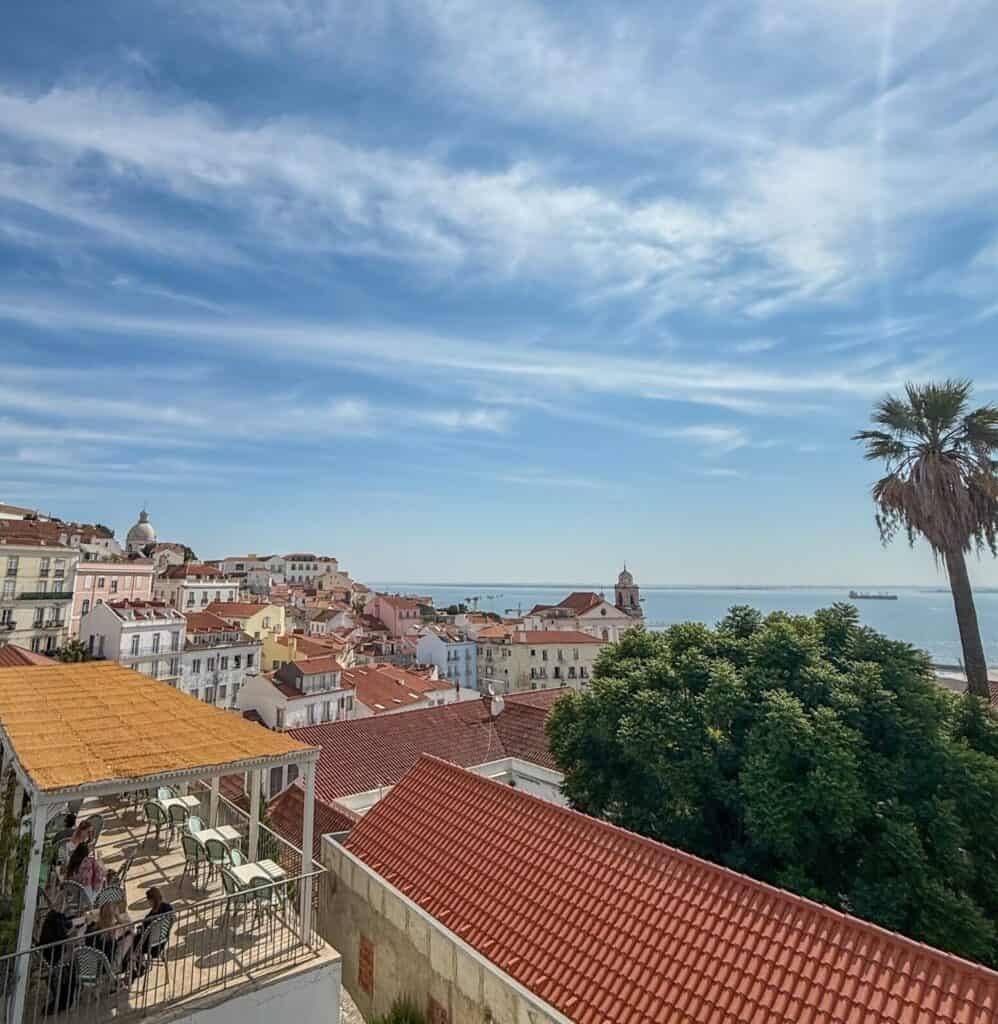
Start at Sé de Lisboa, the cathedral marking the edge of the old town. As you walk up the hill, you’ll find yourself at Miradouro de Santa Luzia, tiled in blue azulejos with flowers spilling over the wall. You cannot go to Alfama without stopping here. It’s one of the more photographed corners of the city.
Just a little further up the hill, you’ll land yourself at Miradouro das Portas do Sol, a second sweeping view of the city over the rooftops, with the water in the background. It’s one of my personal favorites. Keep an eye out for Tram 28 winding through this stretch as it’s the route most associated with the neighborhood.
From there, head through some street vendors to Miradouro do Recolhimento, my favorite of the bunch. It sits tucked into the old castle grounds nearby, typically making it less crowded. You’ll get a great view of the city in the opposite direction of the last two viewpoints.
Close by is Castelo de São Jorge, a Moorish fortress captured in 1147 by Afonso Henriques, Portugal’s first king. It sits on the highest point in the city with sweeping views over the rooftops and the river. I’ve skipped paying to go inside on both visits and put that €15 elsewhere, mostly because Alfama’s free viewpoints are extraordinary on their own.
Graça
From here, Graça is a further climb north, totally worth it if your legs have anything left after Alfama. Igreja de São Vicente de Fora marks the start of the neighborhood, a 17th-century monastery with twin bell towers visible from most of the viewpoints below it. Jardim Botto Machado sits just past it, home to a 188-meter tiled mural by street artist André Saraiva, one of the largest pieces of street art in the city.
Miradouro da Graça caps the climb, the best angle back toward the castle you’ll get all day. It’s a close second to Recolhimento for me, looking out over a completely different side of the city, so it’s less a competition than two favorites for two different views.
The first time I visited the hills of Alfama and Graça, I lost an entire afternoon without meaning to, just taking it all in with no plan. That’s not a warning, budget more time than you think you’ll need, especially if the castle grounds in Alfama are something you want to see properly rather than glance at from outside.
The Afternoon Fork: Go Further or Slow Down
That leaves the afternoon with two options.
Option A: Spend the afternoon in Belém. If it’s on your list, this is the day for it. It’s about 30 minutes away by train from the main station in Cais do Sodré, and a natural pairing with an Alfama/Graça morning. I haven’t been myself, weather or energy got in the way both times, so I can’t give you the full walkthrough the way I can for the rest of this trip.
What I can tell you is what it’s known for: Belém is where the money from Portugal’s Age of Discovery got spent. Vasco da Gama launched his voyage to India from here, and what came back funded Belém Tower and Jerónimos Monastery.
Both are built in Manueline style, Portugal’s own ornate spin on late Gothic, all stone rope and coral carved into the walls. The Monument to the Discoveries sits nearby too, a slab shaped like a ship’s prow, lined with statues of the explorers and royals who financed it all.
The original Pastéis de Belém bakery, where monks invented the pastry after Portugal shut down its religious orders, still turns them out a few steps from the monastery.
Option B: Stay in the city, or cross the river. If Belém isn’t calling, or you’d rather not rush it after a full morning, the simplest move is to just stay put: keep wandering, sit somewhere with a view, maybe grab another pastel de nata, and let the day slow down.
If you want a change of scenery instead without the distance, a sunset river cruise gets you the skyline from the water, or take the ferry across to the neighborhood of Almada, about 7 minutes each way, for a glass of wine along that side of the river. I haven’t made it across myself, but a few locals have recommended it, and either one pairs well with a slower Alfama morning.
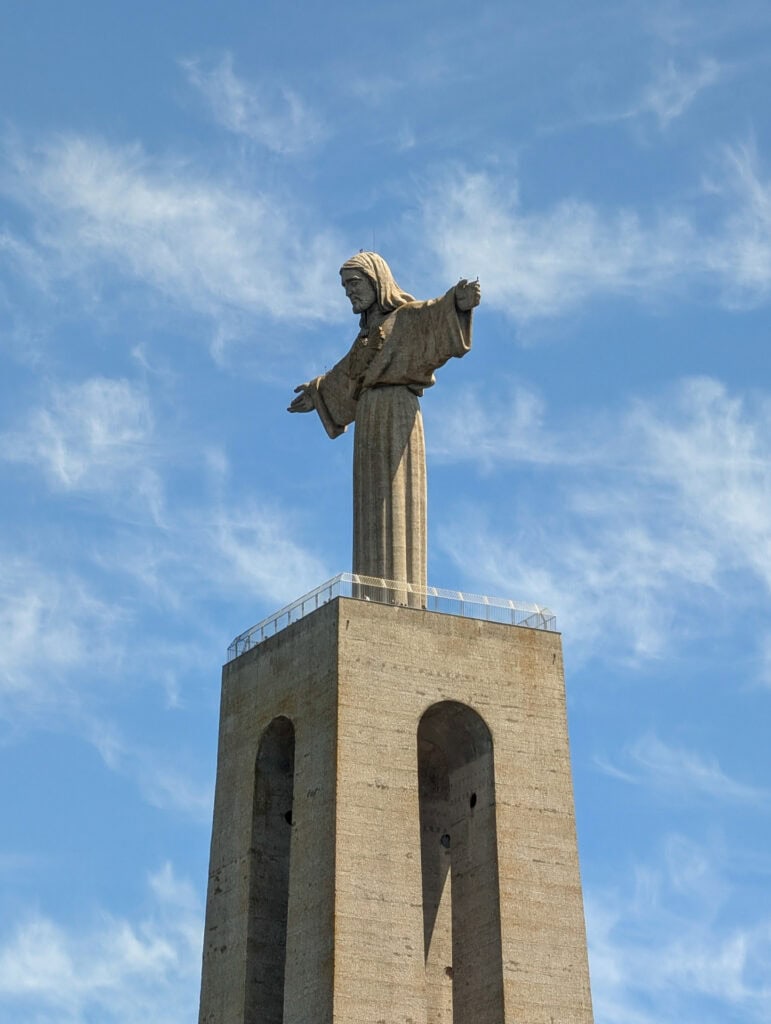
From the Almada side, you’ll spot the Cristo Rei statue, Lisbon’s own version of Rio de Janeiro’s Christ the Redeemer, near the Ponte 25 de Abril bridge. The bridge gets compared to San Francisco’s Golden Gate constantly, and on sight it’s very similar. However, it’s interesting because the builder of Ponte 25 de Abril is the same as San Francisco’s Bay Bridge, the American Bridge Company, not the Golden Gate.
Day 3: Sintra and Cascais in One Day
I’ve done this combined day trip twice, once by public transit plus an Uber, once with a rental car that let me swap the order around. Both times, it was a lot to fit into one day, and both times I finished it more tired than the rest of this itinerary leaves you. I strongly recommend booking a combined tour that visits both if you’re doing this!
Sintra
Sintra is a misty hill town Portuguese royalty used to escape to, several degrees cooler than Lisbon and just far enough to feel like an actual break from the city. Bring an extra layer even if it’s warm when you leave, the temperature and wind really can shift considerably.
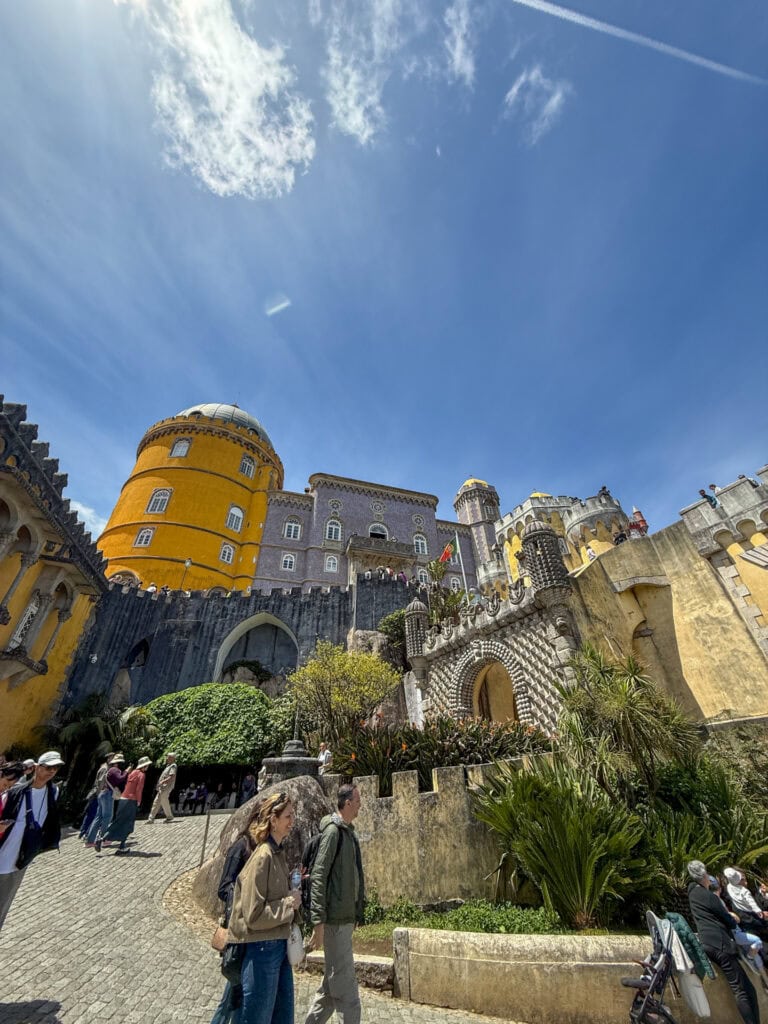
Sintra National Palace sits in town, fairly understated compared to what’s up the hill, though still worth a visit if time allows. Pena Palace, at the top, is King Ferdinand II’s 19th-century fantasy, clashing colors and towers meant to be seen from a distance rather than studied up close. The entrance ticket also includes the grounds, which I still haven’t had proper time for.
Cascais
Cascais, by contrast, is a relaxed beach town, an old fishing village turned royal summer retreat turned laid-back coastal escape. It’s the better half of this day trip to slow down in. Stop by Unity Coffee Roasters for a good coffee if you’re just passing through or starting early and need some caffeine and a quick bite. Otherwise, walk past Praia da Rainha for a proper sit-down meal along the waterfront if your timing allows.
At minimum, walk along Av. Rei Humberto II de Itália, past the Marina de Cascais and along Baía de Cascais. Keep an eye out for a mural of two clasped hands on a building along the way. Keep along the same road until you hit Boca do Inferno, ‘Devil’s Mouth.’ It’s a dramatic sea cave about 20 minutes west of town that’s magnificent to witness the crashing waves against the coves cut into the cliffs. You can loop back to the main downtown by the train station and Unity Coffee afterwards, through the neighborhoods enjoying seeing how the locals live.
The Two Ways I’ve Done This Day
The first time, I used public transit and started at Pena Palace around 10am, an hour after opening, then caught an Uber to Cascais before catching the train back for dinner. The train schedule ended up dictating how much time I spent in Cascais, and I left wanting more. The second time, I had a rental car, and flipped the order: Cascais around 9am, a timed Pena Palace entry at 2pm, then the Sintra National Palace afterward since the car gave a little more flexibility.
I’ll be upfront: it’s been a little stressful both times, watching the clock to stay on schedule. It’s doable, but it’s enough of a logistical headache that I’d now recommend booking a combined tour instead, just to hand the timing off and enjoy the day.
If you’re still sold on doing this yourself, many guides will say to visit Sintra before Cascais to beat the crowds. Mixed news on that, from someone who’s done it both ways: Sintra is crowded regardless of when you show up. I’ve been in November and May, mornings and afternoons, and it hasn’t made a real difference. There are always people.
Plan your order around what tickets and tours are available, not around avoiding people, and prepare for crowds either way. If you want to pull both into a single day without feeling like you’re running between them, I lay out both routes step by step in my post on Sintra and Cascais in One Day (coming soon!)
The Catch: Combining Them
Cascais is the place that suffers most when you combine both in a day. It’s possible, I’ve proven it twice now, but you’ll feel rushed and leave wanting more of both places. If your schedule has any flexibility, splitting these into two separate days gives each the time it deserves, without being go-go-go from sunrise.
If you’re set on one day, leave Lisbon by 8 or 9am, Pena Palace opens at 9, and treat it as a full day, not a leisurely one.
Worth Knowing
The train out to Sintra fills up fast, especially on weekdays since it’s a commuter line, and by mid-morning you’re often standing for the 30-minute ride out. If you’re taking the train rather than driving or booking a tour, leave earlier than feels necessary.
Want a Slower Version? Add a 4th Day
If I had a fourth day, without hesitating I’d split Sintra and Cascais into their own trips. I know the objection. They’re close enough that going back and forth feels wasteful. Maybe that’s true. But a full day in each, instead of splitting one day between them, is a noticeably more relaxed trip.
|
3 Days (this itinerary) |
4 Days (split itinerary) |
|
|
Sintra & Cascais |
Combined into a single day |
Split across two separate days |
|
Guided Tour |
Worth it to offload the stress |
Optional, this pace doesn’t necessarily need it |
|
Pace |
Full and a little tight |
Full and unhurried |
|
Best For |
First-timers who want to see it all |
Anyone who can add a day and doesn’t want to feel rushed |
Here’s specifically what I’d use that extra time for: at least an hour exploring the Pena Palace grounds instead of rushing past them. I’d also add Quinta da Regaleira, an estate built around a spiral staircase called the Initiation Well, nearly impossible to fit in without an organized tour or a full day of your own. In Cascais, I’d want an actual sit-down meal and time to browse the storefronts instead of a fast walk through town.
Most of us inevitably will rush at some point on vacation to see the most, but whether we actually enjoy it more that way is a fair question. A fourth day is how you find out, without needing to sleep for 12 hours once you’re home.
Working with less time instead? Check out my 1 Day in Lisbon post built specifically for cruise ports and long layovers, or anyone simply short on time.
Where to Stay
For a first-timer with no other context, stay in Chiado. It’s close to Baixa and most tour meeting points, about 10 minutes from Time Out Market, and walkable to nearly everything. Next time I’d probably push closer to Bairro Alto, since I keep ending up there for dinner, but that’s a minor adjustment, not a real complaint.
Why Base Yourself in Chiado
I’ve stayed in two very different spots, and the difference mattered more than I expected it to. On the first trip, I stayed on points at the Sheraton Lisboa Hotel & Spa in in the Avenidas Novas neighborhood, well north of everything, about a 40-minute walk to Baixa. It’s a great 5-star hotel on its own terms, but Avenidas Novas and the surrounding neighborhoods are where a lot of the affordable big chain hotels sit, unfortunate if you’re trying to redeem points somewhere central.
That’s not to say you can’t redeem points somewhere central, just that the cost runs well above local chains or an Airbnb.
On the second trip, I stayed on the southern end of Chiado, close to the river, and it was a clear upgrade: everything was a 15 to 20 minute walk away, except Alfama, which I still wouldn’t stay in unless you’re relying on a car for the hills.
Still undecided? Check out my post on where to stay in Lisbon, where I break down every popular neighborhood.

Where I’d Book
I always gravitate toward apartment-style properties that feel like hotels, the space of an Airbnb without losing the polish.
- Splurge: Ando Living’s Flores 25 House, or really any of their properties. I’ve stayed with this company in a few cities now and they’re some of my favorite stays, and their Chiado properties are about as well-located as it gets.
- Mid-range: Le Consulat, similarly central for a lower price, or Casa do Barão, a little closer to the water.
- Budget: Borges, still centrally located while saving some money.
Getting There and Around
From the Airport
- Metro: the budget option. Take the Red Line from Terminal 1, transferring to the Green Line at Alameda for Baixa or Chiado. About €0.50 for a reusable Navegante card plus €1.90 for the ride, 20 to 30 minutes.
- Bus: the Aerobus and public buses connect the airport to the center, around €4 one-way, 30 to 35 minutes in traffic.
- Taxi or Uber: the simplest option, and the one I always default to. Usually somewhere around €10 to €20, 15 to 20 minutes.
Around the City
I lean on my own two feet, plus the commuter trains out to Sintra and Cascais, and I’d recommend the same to most visitors. The trams are mostly a photo op at this point, packed with tourists angling for a shot rather than going anywhere useful, and taxis sit in the same traffic as everyone else.
Selfishly, it also helps me justify how much I indulge in local food on vacation, and it’s the only way you’ll catch the details a car or tram carries you past. You might miss a really neat tiled doorway, the varying mosaic tile patterns underfoot, a cat asleep on a windowsill with its kittens nearby, or a really cool bar to grab a drink at.
If you want a car for a day trip out to Cascais or Sintra, rent it for that day only. Parking in the city center is expensive, and driving through it is worse, dodging pedestrians on streets that weren’t built with cars in mind.
Practical Tips
A Few Quick Things
- Carry a reusable water bottle. Tap water’s safe everywhere, and free public fountains are common, no reason to keep buying plastic in the heat.
- Pickpocketing isn’t as common here as in some other European cities, but it happens in crowded spots like Tram 28 or a packed miradouro. Normal awareness is enough, this isn’t a place that should make you nervous.
- Tipping isn’t obligatory or anywhere close to the US. Round up for drinks or leave 10% for good sit-down service, nobody’s expecting American-style tipping.
Lisboa Card: Buy or Skip
No, and the math tends to back that up. The 72-hour version runs about €62, roughly €21 a day, against a plain transit pass at about €7.25. It only becomes worth it once you’re hitting two or more paid attractions a day.
|
Lisboa Card (72hrs) |
Transit Pass Only |
|
|
Cost |
€62 total (~€21/day) |
€7.25/day |
|
Includes |
Unlimited transit + 50+ attractions |
Transit only |
|
Worth It If |
You’re hitting 2+ paid attractions per day |
You’re mostly walking, skipping paid entries |
Going hard on the Castle, Belém, and both Sintra palaces, run your own numbers. Walking most places and skipping paid entries more often than not, like me, save the money and buy single tickets as you go.
Frequently Asked Questions
Is 3 days enough time in Lisbon?
For the city itself, yes, and I’d call it the minimum rather than the ideal. You’ll cover the highlights without feeling like you’re jogging through them. Add Sintra and Cascais on top and it starts to feel tight, that’s the tradeoff this whole itinerary is built around. 4 or 5 days lets you slow down without cutting anything.
Do you need a car in Lisbon?
No, and I’d actively avoid one for the city itself. Parking is expensive, traffic is unpredictable, and most of what you’ll want is walkable or a short Metro ride away. A rental only makes sense for a single day out to Sintra or Cascais, and even then, transit handles it fine if you’d rather not deal with parking there either.
Can you really do Sintra and Cascais in one day?
Yes, but something gives, and in my experience it’s always Cascais. If your schedule has any flexibility, splitting them into two separate days is the better version of this trip, and it’s the version I’d pick if I were planning this from scratch again.
Do you need to speak Portuguese?
No. English is widely spoken in tourist areas, restaurants, and hotels, especially with anyone under 40. Learning a few basics, obrigado/a for thank you, bom dia for good morning, goes a long way and costs you nothing.
Reasons to Come Back
The best moments here for me weren’t on any list. My dad and I found a great tap room because we took a wrong turn looking for something else. My boyfriend and I stumbled into a neighborhood street market the same way. Once you’ve hit the highlights, let yourself get a little lost on purpose.
Lisbon gets a little more comfortable each time I’m back, not because it’s changed, but because I stop trying to see all of it at once. There’s still a version of this trip I haven’t taken: the one where I finally make it to Belém, or spend a real, unhurried day inside Pena Palace’s grounds instead of glancing at them on my way to the next thing, or actually make it across the river to Almada for that sunset. I’m not in a rush to check those off. Some cities are worth leaving unfinished, it just gives you a reason to come back.
Pin For Later!